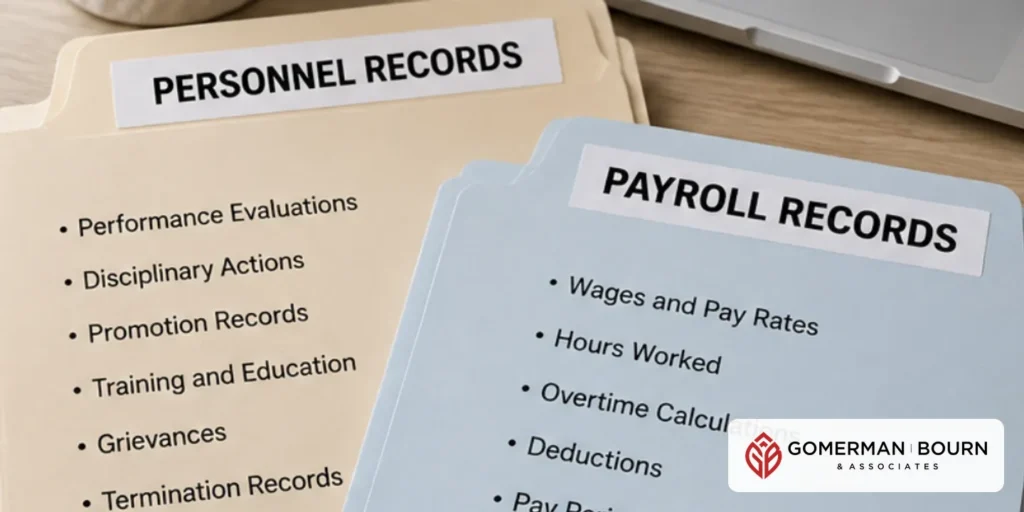
Quick Answer: Personnel records generally relate to an employee’s performance, qualifications, discipline, promotion, and workplace grievances. Payroll records generally document wages, hours, pay rates, deductions, and other information required to show how an employee was paid. California law gives current and former employees separate rights to request these categories of records, and the response deadlines are different.
If you are trying to understand what your employer has documented about your work history, you may be wondering whether personnel records and payroll records are the same thing. They are not.
Personnel records generally focus on the employment relationship itself. Payroll records focus on wages, hours, and compensation. The distinction matters because different California laws govern what employees may request, what employers must provide, and how quickly an employer must respond.
This article explains the difference, what each category commonly includes, and why these records may matter when questions arise about discipline, termination, retaliation, or unpaid wages.
Disclaimer: This article is for general informational purposes only and does not constitute legal advice. Employment record rights can depend on the facts, the type of record requested, and any applicable exceptions.
Key Takeaways
- Personnel records document performance and employment decisions; payroll records document wages, hours, and deductions.
- Personnel records fall under Labor Code § 1198.5 — written request, 30-day deadline. Payroll records fall under § 226 — written or oral request, 21-day deadline.
- Filing a lawsuit over a personnel matter temporarily suspends the § 1198.5 right, but generally not the § 226 right to payroll records.
- Employers must generally keep both categories of records for at least three years.
- Both sets of records often become key evidence in termination, retaliation, discrimination, and wage disputes.
Personnel Records vs. Payroll Records: The Key Difference
The simplest way to understand the difference is to look at what each category is designed to document.
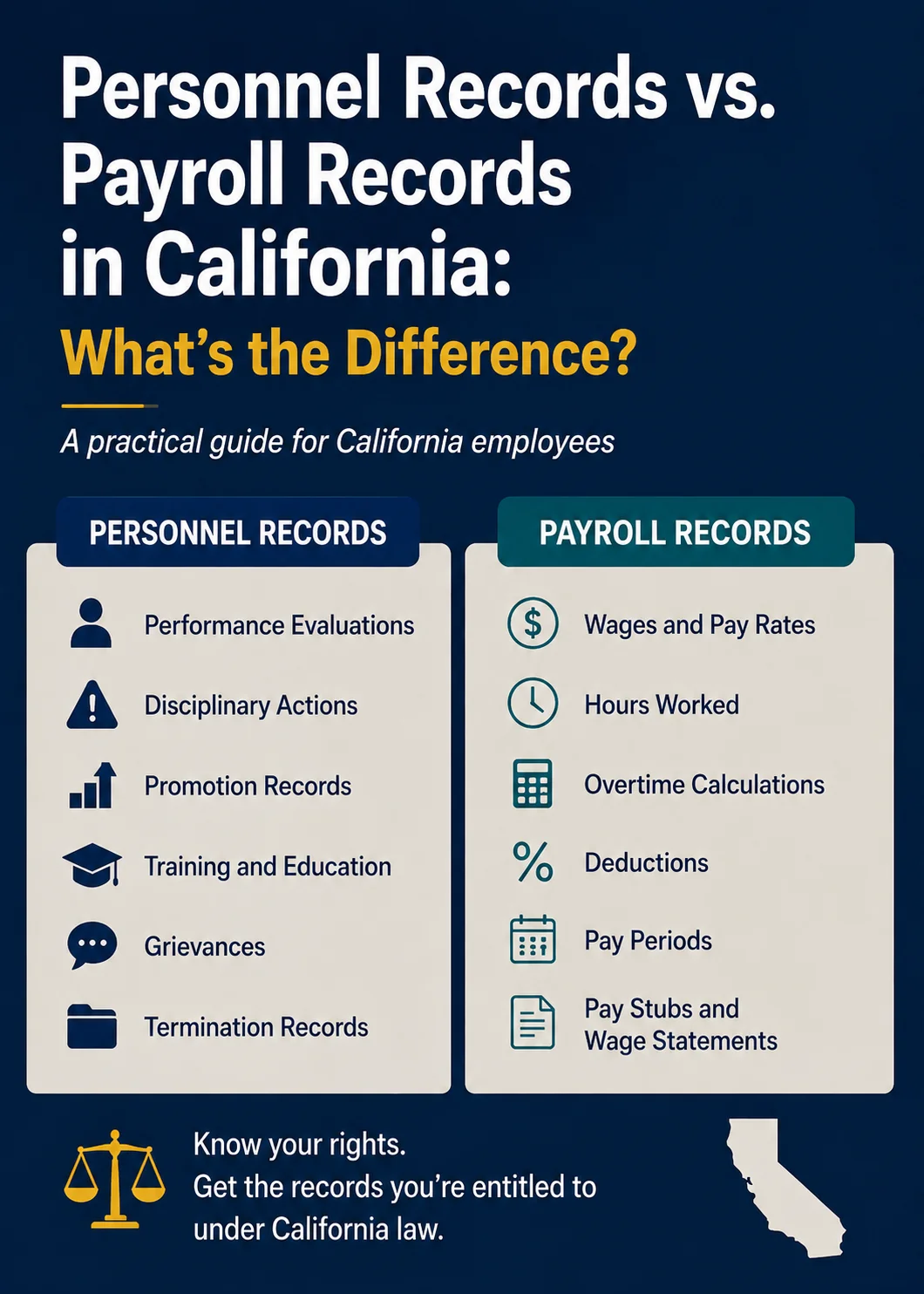
| Personnel Records | Payroll and Wage Records |
|---|---|
| Performance evaluations | Gross and net wages |
| Warnings and disciplinary notices | Hours worked and pay rates |
| Promotion and qualification records | Overtime and piece-rate information |
| Education and training records | Deductions and pay-period dates |
| Grievances concerning the employee | Timekeeping records |
| Termination-related performance records | Itemized wage statements |
Personnel records focus on employment decisions and performance. Payroll records focus on compensation and wage compliance.
What Are Personnel Records?
Under California Labor Code section 1198.5, current and former employees generally have the right to inspect and receive copies of personnel records that relate to their performance, including education or training records, or to a grievance concerning them.
Examples may include:
- Performance reviews and appraisals
- Written warnings and disciplinary notices
- Notices of commendation, layoff, leave, or termination
- Records used to evaluate an employee for promotion or additional compensation
- Attendance records
- Education and training records
- Documents concerning a grievance involving the employee
Not every document an employer keeps is automatically part of the records an employee is entitled to inspect. California law excludes certain materials, including letters of reference, records concerning the investigation of a possible criminal offense, and certain examination-related records. Employers may also redact the names of nonsupervisory employees before producing records.
Important distinction: Documents such as offer letters, employment agreements, or other instruments signed by an employee may be available under a separate California law, Labor Code section 432, even when they do not fall within the precise scope of section 1198.5.
Why Personnel Records Matter
Personnel records can help show how an employer documented an employee’s performance and the reasons given for an employment decision. They may become important in matters involving:
- Wrongful termination
- Retaliation
- Workplace discrimination or harassment
- Failure to promote
- Disciplinary or performance disputes
What Are Payroll Records?
Payroll and wage records document how an employee was paid. California Labor Code section 226 requires employers to provide itemized wage statements and gives current and former employees the right to inspect or receive copies of qualifying records pertaining to their employment.
These records commonly include:
- Itemized wage statements or pay stubs
- Gross and net wages earned
- Total hours worked, when required
- Regular and overtime rates and the hours paid at each rate
- Pay-period dates
- Deductions
- Piece-rate units and rates, when applicable
- Timecards and other required timekeeping records
Depending on the compensation arrangement, other records may also be relevant, such as commission agreements, incentive-plan formulas, and records showing how commissions or bonuses were calculated.
Why Payroll Records Matter
Payroll records often become central evidence in disputes involving:
- Unpaid wages
- Overtime violations
- Minimum-wage violations
- Meal and rest period claims
- Commission disputes
- Final-paycheck issues
- Inaccurate wage statements
California Employee Rights to Request Records
California provides separate procedures and deadlines for personnel records and payroll records.
| Record Type | Primary Law | Request | General Deadline |
|---|---|---|---|
| Personnel records | Labor Code § 1198.5 | Written request | No later than 30 calendar days, unless extended by written agreement |
| Payroll and wage records | Labor Code § 226 | Written or oral request | As soon as practicable, but no later than 21 calendar days |
An employer may charge the actual cost of reproducing copies. Additional rules apply to where records must be made available, former-employee requests, representative requests, and lawsuits involving personnel matters.
What If You Have Already Filed a Lawsuit?
Many employees are surprised to learn that filing a lawsuit can affect their right to request certain employment records.
Under California Labor Code section 1198.5, employees generally have the right to inspect and receive copies of qualifying personnel records. However, if an employee files a lawsuit that relates to a personnel matter, that statutory right is temporarily suspended while the lawsuit is pending. In most cases, the employee will obtain those records through the civil discovery process instead of making a request under Labor Code section 1198.5.
This limitation applies only to personnel records requested under Labor Code section 1198.5. It does not automatically prevent an employee from requesting qualifying payroll and wage records under California Labor Code section 226, which is governed by a separate law with different requirements.
Understanding this distinction can help employees know what records may still be available during litigation and avoid unnecessary delays or confusion.
Why the Distinction Matters in Employment Disputes
Many employees assume that every employment document is kept in one file. In reality, employers may maintain separate personnel, payroll, medical, benefits, leave, and investigation records. The records that matter most depend on the issue involved.
Wrongful Termination and Discipline
Personnel records may show performance evaluations, warnings, performance improvement plans, disciplinary actions, and the employer’s stated reason for termination. A timeline of those documents may help an employee understand how the employer documented the decision.
Retaliation and Discrimination
Personnel records may help show changes in evaluations, discipline, assignments, or other employment decisions after an employee complained about workplace conduct or exercised a protected right. Other records outside the personnel file may also be important, including emails, text messages, complaint records, and investigation materials.
Wage and Hour Claims
Payroll and timekeeping records may help compare the hours an employee worked with the wages the employer paid. They can also help identify pay-rate changes, missing overtime, deductions, or wage-statement errors.
Not sure which records apply to your situation? Our California employment team can help you understand what to request and what your records may show. Your consultation is free and confidential.
Common Misconceptions About Employee Records
“My personnel file includes every document my employer has about me.”
Not necessarily. Employers often maintain different categories of records, and the right to inspect under Labor Code section 1198.5 is limited to records relating to performance or grievances, subject to statutory exceptions.
“Payroll records are just pay stubs.”
Pay stubs are important, but payroll and wage records can also include required timekeeping information and other records showing hours, rates, deductions, and how compensation was calculated.
“I need to wait until a lawsuit is filed before requesting records.”
No. Employees often request records before deciding whether legal action is necessary. However, section 1198.5 contains a litigation-related limitation when a lawsuit concerning a personnel matter is already pending, so legal advice may be helpful before making a request in that situation.
Best Practices for Employees
When permitted, employees may want to keep organized copies of important documents as they receive them. Helpful records may include:
- Pay stubs and time records
- Offer letters and employment agreements
- Commission or bonus plans
- Performance reviews
- Written complaints and employer responses
- Warnings, disciplinary notices, and performance improvement plans
- Written communications concerning schedules, pay, leave, or changes in employment status
Employees should avoid taking confidential company information, trade secrets, privileged materials, or records they are not authorized to possess. When in doubt, speaking with an employment attorney before copying or removing documents can help avoid additional issues.
How Long Must California Employers Keep These Records?
California law generally requires employers to retain personnel records covered by Labor Code section 1198.5 for at least three years after termination. Copies of itemized wage statements and deduction records must generally be kept for at least three years, and payroll records showing daily hours worked and wages paid must also be retained for at least three years.
Other federal, state, or local laws may require longer retention periods for particular records. The applicable period can depend on the type of document and the legal issue involved.
When Should You Contact an Employment Lawyer?
You may want to speak with a California employment attorney if you believe:
- You were wrongfully terminated or disciplined for an unlawful reason
- You experienced retaliation after reporting misconduct or exercising a protected right
- You were subjected to unlawful discrimination or harassment
- Wages, overtime, commissions, or other compensation remain unpaid
- Your employer did not respond to a lawful records request
- The records you received appear incomplete, inconsistent, or different from what you were previously told
Every situation is different. An attorney can review the documents, evaluate the timeline, and explain which laws may apply to your specific circumstances.
Frequently Asked Questions
What is the difference between personnel records and payroll records in California?
Personnel records generally relate to performance, qualifications, discipline, promotion, and grievances. Payroll records generally relate to wages, hours, rates, deductions, and how compensation was calculated.
Can California employees request their personnel records?
Generally, yes. Current and former employees may submit a written request to inspect or receive copies of personnel records covered by Labor Code section 1198.5, subject to exceptions and procedural requirements.
How long does an employer have to provide personnel records?
Generally, the employer must make the records available or provide copies no later than 30 calendar days after receiving a written request. The parties may agree in writing to extend the deadline by up to five additional calendar days.
Can California employees request payroll records?
Yes. Current and former employees generally have the right to inspect or receive copies of qualifying payroll and wage records pertaining to their employment.
How long does an employer have to provide payroll records?
The employer must comply as soon as practicable, but no later than 21 calendar days after receiving a written or oral request.
Are performance reviews part of personnel records?
Usually. Performance reviews directly relate to employee performance and are a common example of records covered by section 1198.5.
Are timecards payroll records?
Timecards and required timekeeping records are generally considered wage and hour records because they document hours worked and support payroll calculations.
Can an employer refuse to provide every document in a personnel file?
An employer does not have to produce every document it maintains. Statutory exceptions apply, and some records may fall outside the scope of section 1198.5. The employer may also redact the names of nonsupervisory employees.
What can an employee do if the employer does not comply?
California law provides potential penalties and court remedies for certain failures to provide personnel or payroll records. The available remedy depends on the type of request and the facts, so an employee may want to speak with an attorney or contact the Labor Commissioner.
Can I request my personnel file if I have already filed a lawsuit against my employer?
Generally, no. If you have filed a lawsuit that relates to a personnel matter, California Labor Code section 1198.5 temporarily suspends your statutory right to inspect or receive copies of qualifying personnel records while the lawsuit is pending. In many cases, those records are obtained through the litigation discovery process instead. This limitation generally does not apply to qualifying payroll and wage records requested under California Labor Code section 226.
Understanding Your Records Can Help You Understand Your Rights
Personnel and payroll records tell different parts of an employee’s story. One may show how the employer evaluated and treated the employee. The other may show whether the employee was paid correctly. Reviewing both categories can help clarify what happened and what questions still need to be answered.
At Gomerman | Bourn & Associates, we help California employees understand their workplace rights and evaluate records involving termination, retaliation, discrimination, harassment, and unpaid wages. If you have questions about your employment records or believe your employer has violated your rights, speaking with an experienced employment attorney can help you understand your options.
Legal References
- California Labor Code § 1198.5 — Personnel Records
- California Labor Code § 226 — Wage Statements and Employee Access
- California Labor Code § 1174 — Payroll Recordkeeping
- California DLSE — Personnel Files and Records FAQ