
E-Bike Accident Claims: How Speed Classifications Affect Your Case
- Kimberly Ferrato

- 9 hours ago
- 5 min read
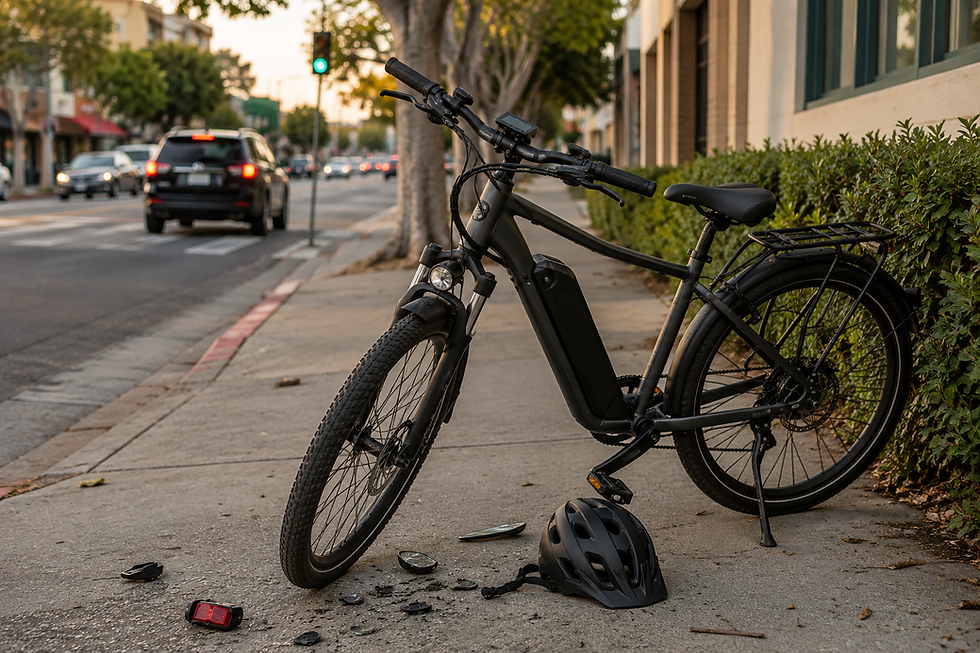
Electric bikes, more commonly known as e-bikes, have rapidly grown in popularity across California in recent years. From commuters navigating crowded city streets in San Francisco to recreational riders exploring scenic trails throughout Sonoma County and the Bay Area, e-bikes offer a convenient, eco-friendly, and efficient alternative to traditional transportation. However, as e-bike use continues to rise, so does the number of serious accidents involving riders, motorists, pedestrians, and defective equipment.
E-bike accident claims are different from standard bicycle accident claims due to the nature of their speed. The classifications of speed may directly affect where riders are legally allowed to operate their bikes, whether helmet laws apply, how insurance companies evaluate liability, and what compensation may be available. In some cases, speed is a determining factor in whether an injured rider is considered partially at fault for an accident.
What Is an E-Bike Under California Law?
Under California Vehicle Code Section 312.5, an electric bicycle is generally defined as a bicycle equipped with fully operable pedals and an electric motor producing less than 750 watts of power. To protect public safety, any vehicle modified to exceed 750W or travel faster than the class limits is legally classified as a moped or motorcycle.
Under California law, e-bikes are divided into the following:
Class 1: pedal-assist only, with a maximum assisted speed of 20 mph. There are no age requirements to operate, but helmets are required for those under 18.
Class 2: throttle-assisted, with a maximum speed of 20 mph. There is no statewide minimum age and helmets are required for those under 18.
Class 3: pedal-assist only, with a maximum speed of 28 mph. The minimum age is 16 and helmets are required for all ages.
Understanding these distinctions is critical after an accident, especially when insurance companies or opposing parties attempt to dispute liability based on how the e-bike was being operated at the time of the collision.
How Speed Classification Can Affect Liability in an Accident Claim
The speed classification of an e-bike plays a major role in determining liability after an accident in California. The three-class e-bike system regulates where certain e-bikes may be ridden, how fast they may travel, and what safety requirements apply. After an accident, insurance companies and opposing parties may closely examine whether the rider was operating the e-bike legally at the time of the incident.
California follows a comparative negligence system, meaning that an injured person’s compensation may be reduced if they are found partially responsible for the accident. In many e-bike accident claims, defense attorneys may argue that the rider was traveling too fast for road conditions, weaving through traffic, failing to obey traffic signals, or operating an e-bike beyond its lawful classification. Even when a motor vehicle driver caused the collision, insurers may still attempt to reduce payouts by claiming the rider’s speed or conduct contributed to the crash.
Injuries Commonly Seen on E-Bikes
The injuries seen on e-bikes are often more severe than standard bicycle injuries, resulting in higher hospital admission rates. The combination of greater vehicle weight and faster speeds, significantly intensifies the force of an impact. According to data from the National Institute of Health, injuries may involve:
Traumatic brain injuries (TBIs)
Spinal cord injuries
Orthopedic fractures
Facial and dental trauma
Internal organ injuries
Soft tissue injury and severe road rash
Death
Compensation Available After an E-Bike Accident
Because electric bicycles travel at much higher speeds and carry significantly more weight than traditional bicycles, the physical trauma resulting from a collision is often catastrophic. A personal injury claim can secure vital funds to cover immediate emergency room bills, ongoing physical therapy, future surgical interventions, and lost wages from missed work.
If your crash was caused by someone else's negligence, a personal injury claim can secure vital funds for your recovery. This includes:
Medical Expenses: Coverage for your immediate emergency room bills, ongoing physical therapy, medications, and future surgical interventions.
Lost Income: Reimbursement for wages missed while recovering, as well as diminished future earning capacity if you suffer a permanent disability.
Pain and Suffering: Compensation for your physical pain, emotional distress, PTSD, and the lasting trauma of severe road rash scarring or facial disfigurement.
Property Damage: Funds to repair or replace your e-bike, helmet, and riding gear.
Steps to Take Right After an E-Bike Crash
Move to Safety: get off the roadway to prevent a secondary collision
Call 911: Request emergency medical services
File a Police Report: Ensure that responding officers document the crash and request a copy of the official police report number before they leave the scene.
Exchange Information: Collect names, phone numbers, driver’s license numbers, and insurance information from all drivers and cyclists involved.
Document the Evidence: Take photos and videos on injuries, any damages to your e-bike, the at-fault vehicle’s license plate, and any road hazards or traffic signals
Seek Immediate Medical Care: Go to an emergency room or urgent care right away. High-velocity e-bike impacts often cause internal injuries or concussions that do not show symptoms immediately.
Don't let anyone tell you to repair, reset, or throw away your e-bike after a crash. Your e-bike may be one of the most important pieces of evidence in your case. Many modern e-bikes record valuable data, including your speed, GPS route, distance traveled, and ride history through the bike's display or connected apps like Strava. That information can help prove you were riding responsibly and counter claims that you were speeding or otherwise at fault. Preserve your e-bike exactly as it was at the time of the collision. Do not repair it, replace parts, reset its electronics, or delete any ride data until your attorney has had the opportunity to inspect and document it. Protecting this evidence could make a significant difference in your case.
Time Limits for Filing an E-Bike Injury Claim in California
When you are recovering from an e-bike crash, it is critical to know that California law places strict time limits on your right to file a claim. If you miss these deadlines, you lose your right to collect any compensation for your medical bills and injuries. For most accidents caused by a careless driver, pedestrian, or another cyclist, you have exactly two years from the date of the crash to file a personal injury lawsuit. This same two-year deadline applies if a mechanical defect, like a broken frame or a battery fire, caused your wreck and you need to sue the e-bike manufacturer. If you are only trying to get reimbursed for the cost of repairing or replacing your damaged e-bike, helmet, and gear, you have three years to file a property damage claim.
The absolute most urgent deadline applies if a dangerous pothole, a cracked sidewalk, or a poorly designed city bike lane caused your accident. In cases involving public property, you must file a formal claim against the responsible city, county, or state government entity within just six months of the crash. Speaking with an attorney immediately after your crash is the best way to ensure your rights are protected and your deadlines are met. Do not let hidden legal deadlines or insurance company tactics stand in the way of your physical and financial recovery. Contact Gomerman Bourn & Associates today at 888-855-2505 or visit our online consultation page to schedule your 100% free, no-obligation case evaluation.


